BISL Business Information Management
What Is Contract Management in BiSL?
Contract management in BiSL is the process on the steering layer that creates, monitors and improves the agreements about services delivered by IT providers. It covers contracts, SLAs and collaboration agreements, and it forms the interface between business information management and those providers, internal or external.
What is contract management in BiSL?
Contract management is the BiSL process that makes, monitors and improves the agreements about services delivered by IT providers. It sits on the steering layer. Business information management uses it to turn business needs into concrete arrangements, so that what the organisation expects from IT is actually written down and followed up.
The book puts the agreements at the centre: “Bij Contractmanagement staan de afspraken centraal die gerelateerd zijn aan de diensten die door de IT-dienstverleners worden geleverd.” In plain terms, the process is about the services you receive, not about the technology behind them.
The agreements are drawn up together with the line organisation. Business information management manages them primarily from a business perspective, which is why the process belongs to the business side of IT rather than to the IT provider.
Which documents and agreements does contract management produce?
The key products are the IT service contract, the SLA, further agreements within a framework agreement, and collaboration arrangements such as a DAP (Dossier Afspraken en Procedures). Together they record what is delivered and how the parties work together. Contract management also monitors them once they are in place.
In short, the main products are:
- the IT service contract;
- the SLA (service level agreement);
- further agreements within a framework agreement;
- collaboration arrangements, such as a DAP.
The book describes SLAs and related products, plus their monitoring, as an important result of the process. Creating the document is therefore only half the work. Keeping the agreement alive is the other half.
Where does contract management fit among the BiSL processes?
Contract management is one of four steering processes, next to needs management, planning and control, and financial management. It also fills the role of formal commissioning party, which makes it the interface at steering level with the IT providers. The frameworks for it come from supplier management on the directing layer.
The book summarises the interface role like this: “Daarmee vormt Contractmanagement de interface op sturend niveau met de IT-dienstverleners.”
On the steering layer, four parameters guide the work: quality, time and capacity, costs, and service agreements. They are closely related and can conflict. Spending extra time, for example, usually means extra cost. That is why BiSL asks for integrated steering, in which the interdependent trade-offs are weighed together.
The book lists the questions behind such trade-offs:
- Is the required human capacity available, and is it worthwhile to use it in a certain way?
- What are the costs and benefits of the intended decision, and how do they balance?
- Does the decision improve the information provision?
- Can the IT providers actually carry it out?
Why should business information management write the service levels?
Supplier-driven service levels are often highly technical, while the organisation needs levels that reflect its business process. The book is explicit: BIM translates business needs into desired services with a desired quality level, and brings those service levels to the table itself. Cost matters too, since every service level in an SLA costs money.
The book states it directly: “Service levels moeten dus opgesteld en ingebracht worden door BIM, niet door de IT-dienstverleners.” The reasoning is that an offer-driven service level describes what the provider can easily measure. A business-driven service level describes what the business process actually needs.
This also explains why contract management cannot be left to the provider. The provider can propose and negotiate, but the starting point of the conversation has to come from the business side.
Does contract management also apply to an internal IT department?
Yes. The process applies equally when the IT provider is an internal department, because you still want concrete agreements with it. The book states that this internal relationship and its agreements fall within contract management as well. So the process is not limited to external suppliers.
The relevant sentence reads: “Deze interne relatie en afspraken vallen dus ook binnen het proces Contractmanagement.” The service relationship is what matters. Whether the provider sits in the same organisation or outside it, the business still needs clarity about what is delivered and at what level.
How do the form and structure of a service shape the agreements?
Three topics determine how agreements are filled in and steered: the content of the service, its form, and its structure. The form is a choice between a results obligation and an effort obligation. Each brings different steering mechanisms, financial settlement and steering by business information management.
The three topics, as the book frames them:
- Content: what the service contains, and the degrees of freedom;
- Form: the way of steering, either a results obligation or an effort obligation;
- Structure: how the service is built up and who is responsible for what.
The choice of form is about which risks, and therefore which responsibilities, you place with the supplier. A supplier may make certain expertise available. It may also take responsibility for complete change projects or even entire solutions.
The kind of service matters as well. Taking software functionality from a SaaS provider is quite different from running a working information system on a dedicated network environment, and the agreements differ accordingly.
When do you use contract management?
You use it whenever IT providers deliver services that the business depends on and you need those services agreed, monitored and improved. That holds whether you buy SaaS functionality or a working information system on a dedicated network, and whether the provider is internal or external.
Because BiSL steers integrally, contract management is rarely used in isolation. The agreements you make must fit the capacity available and the cost you accept. They must also cover day-to-day operations, not only the changes in the information provision. A service agreement that ignores ongoing operation leaves part of the work unsteered.
The business writes the service levels
In BiSL, contract management makes business information management the party that formulates service levels, for external suppliers and for internal IT alike. The provider delivers against them, but does not define them.
ways to learn about our BISL standard

BiSL® Practitioner courseware – 4de editie
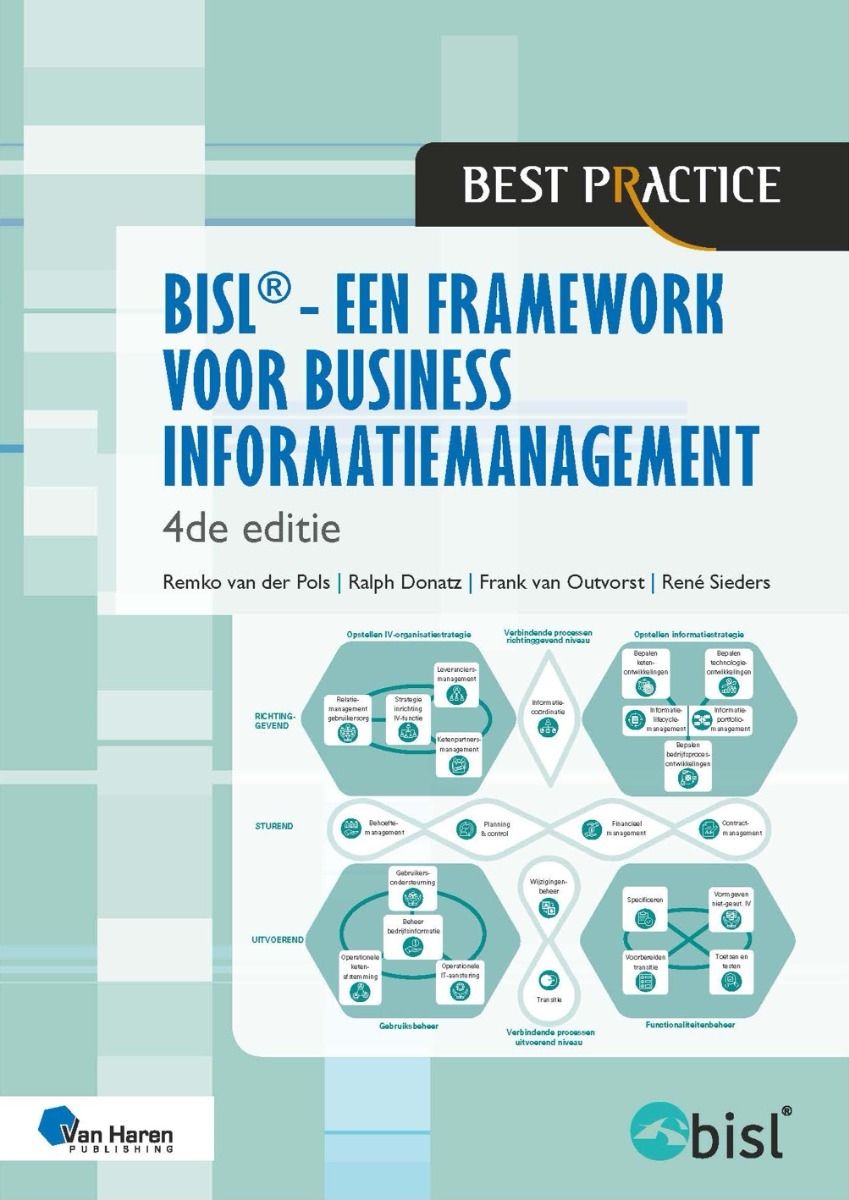
BiSL – Een framework voor business informatiemanagement - 4de editie

Request a quote from a training partner
Frequently asked questions
No. The book contains no model contract or SLA template, no legal provisions, no prices or tariffs, and no penalty clauses or escalation periods. BiSL describes the process and the products that matter, not their legal wording. For drafting and legal review you will need other sources and qualified legal advice.
The book does not say; it sets no norms for service levels. What is reasonable depends on your business process, which is exactly why BIM should derive service levels from business needs and weigh them against cost. Any figure you adopt should come from that analysis, not from a generic benchmark.
People in business information management who must agree services with IT providers benefit most, along with the line managers who help draft the agreements. The book notes that agreements are drawn up together with the line organisation. Whoever commissions IT from external suppliers or from an internal IT department is within scope.
Read “BiSL – Een framework voor business informatiemanagement”, 4th edition, by F. van Outvorst, Ralph Donatz, Remko van der Pols and René Sieders. This article draws on its sections about managing service agreements, forms of service delivery and service levels. The standard page on the Van Haren Group site places the process in the wider framework.